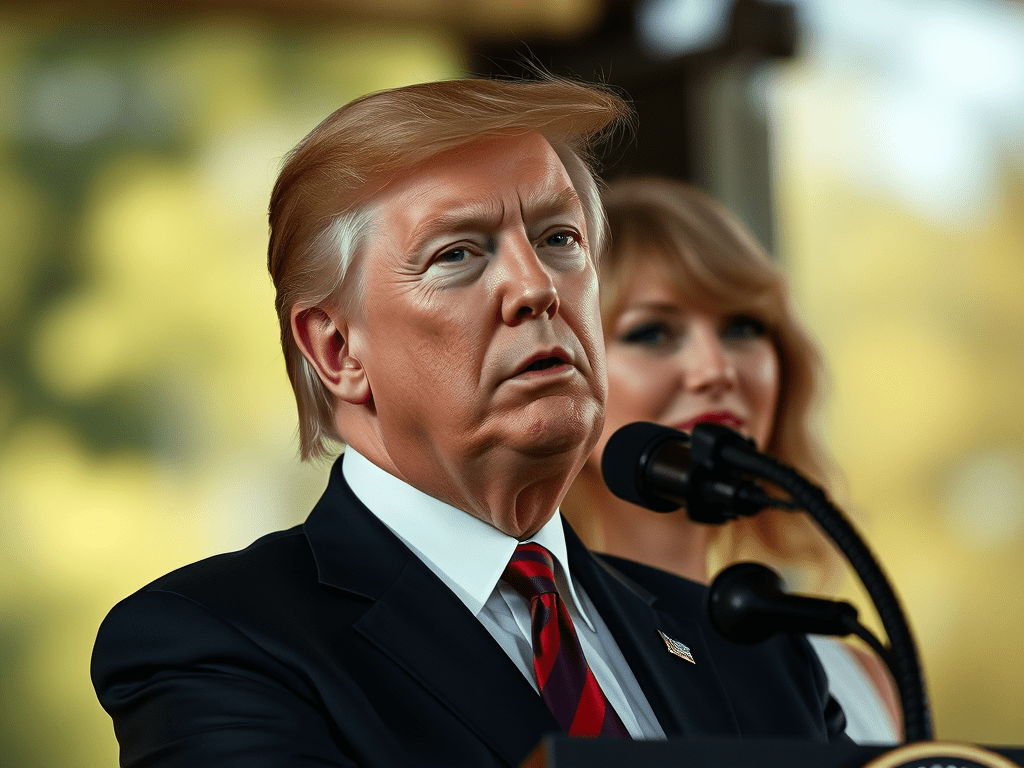
Washington D.C. – May 20, 2025
In a rare public moment of self-reflection, former President Donald J. Trump issued a formal apology on Sunday after controversial remarks he made about pop icon Taylor Swift reignited criticism about his rhetoric and priorities.
The former president, who remains a dominant figure in American politics, faced swift backlash after a recording surfaced last week in which he dismissed Swift’s appearance, commenting on Truth Social.
Swift, known not only for her music but increasingly for her political engagement, has long encouraged civic participation and spoken out on issues such as women’s rights and voter registration. Her popularity and public activism have occasionally made her a target in partisan debates, particularly as she becomes more outspoken.
Trump’s comments were widely condemned as unnecessary and demeaning, even by some of his supporters. Over the weekend, the former president addressed the controversy in a statement posted to Truth Social and later reiterated during a campaign stop in Pennsylvania.
“I want to apologize for what I said about Taylor Swift,” Trump stated. “It was inappropriate, and I understand how it came across—not just to her fans, but to people who expect more from someone in my position. I may not agree with her politically, but that doesn’t justify making personal remarks.”
Trump went on to acknowledge that the country is facing challenges that are “far more important than celebrity spats.”
“There are real issues facing America—our economy, our border, our global standing. I need to focus on those. I will focus on those,” he added. “This is a time for seriousness and unity, and I let myself get distracted.”
Political analysts viewed the apology as an unusual pivot for Trump, who has often doubled down in the face of criticism rather than retracting statements. Some suggest the move reflects an awareness of shifting public sentiment, especially among younger voters who are increasingly influential in national elections.
Taylor Swift has not publicly responded to Trump’s remarks or his apology. Her representatives declined to comment.
Meanwhile, the incident has sparked broader conversations about the role of civility in political discourse and the expectation that public figures—especially those aspiring to national leadership—uphold a higher standard.
“Criticizing someone’s policy stance is fair game,” said Dr. Angela Harmon, a political science professor at Georgetown University. “But personal attacks, particularly those rooted in appearance or gender, not only distract from substantive issues—they erode public trust.”
Trump’s statement concluded with a note of resolution: “I hope we can move past this. I’ll do my part. It’s time to focus on making America stronger—for everyone.”
Whether the apology will resonate with voters remains to be seen. But for now, it marks a notable pause in Trump’s often unrelenting media style—and a reminder of the fine line between celebrity culture and political leadership in modern America.


 A More Empathetic World